
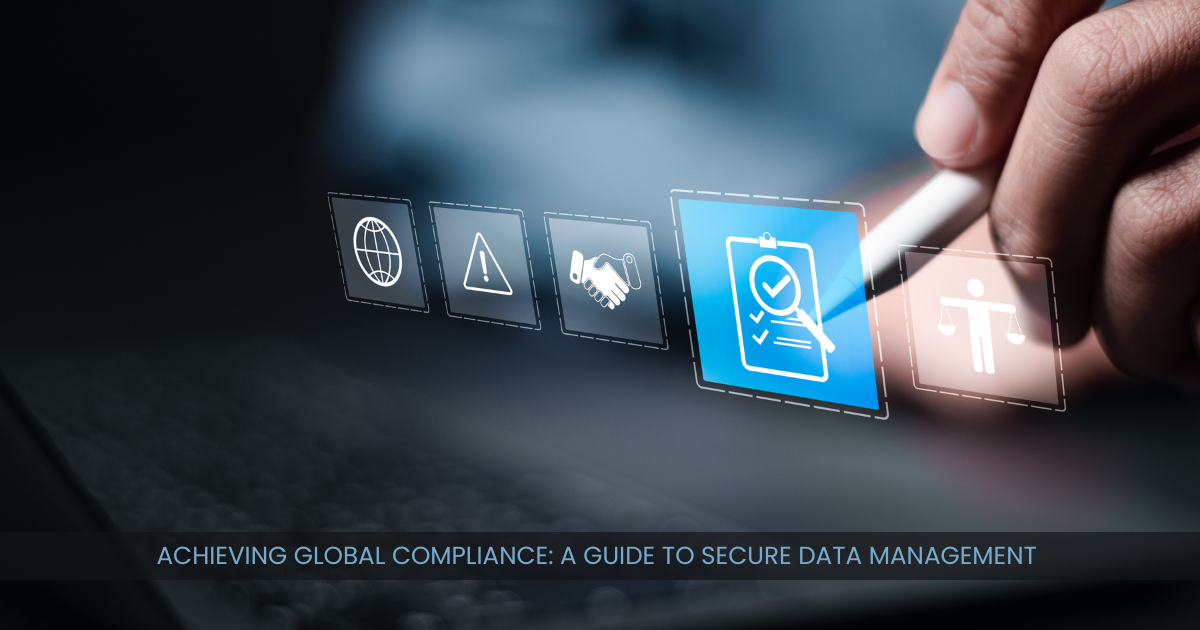
Data breaches can lead to financial losses, legal action, and damaged reputations. Many companies fail to follow proper secure data management protocols, which results in non-compliance with international data regulations.
This guide outlines how businesses can meet global data compliance standards and apply data protection best practices in secure data management. It covers major regulations like GDPR compliance and ISO 27001 compliance, along with actionable strategies and supporting services.
Key regulations driving secure data management
Data privacy compliance requires specific actions. Ignoring these rules leads to serious penalties.
GDPR compliance
The General Data Protection Regulation (GDPR) governs personal data in the EU. Companies must:
- Collect explicit consent before data use
- Provide clear privacy notices
- Report data breaches within 72 hours
Non-compliance may result in fines up to €20 million or 4% of annual global turnover. To remain compliant, businesses must secure data with encryption, access controls, and regular audits.
ISO 27001 compliance
ISO 27001 defines the structure for An Information Security Management System (ISMS). This system helps companies:
- Identify potential security risks
- Apply appropriate security controls
- Maintain a cycle of ongoing improvement
Achieving certification proves a strong commitment to secure data management. It also strengthens stakeholder confidence.
Other global standards
Beyond the EU and ISO standards, companies may face other regional regulations, including:
- California Consumer Privacy Act (CCPA)
- Brazil’s Lei Geral De Proteção De Dados (LGPD)
- Canada’s Personal Information Protection and Electronic Documents Act (PIPEDA)
A company-wide data governance framework ensures alignment with these varied regulations.
The real costs of non-compliance
Failing to meet data compliance requirements causes more than financial loss.
- Direct penalties: Regulators issue heavy fines for poor security or data handling. GDPR fines alone can reach millions.
- Reputational damage: Customers lose trust after data breaches. Recovery takes time and may cost future business opportunities.
- Operational and legal disruption: Legal action often halts operations. Non-compliant firms may also lose access to new markets or partnerships.
Building a data governance framework
A structured data governance framework manages data across its lifecycle. It creates consistency in how companies handle and protect information.
Core components
A working framework should include:
- Data classification: Identify sensitive data and apply proper safeguards
- Access controls: Limit access to authorized users based on roles
- Audit trails: Record data access and changes for full traceability
- policy enforcement: Define and apply clear rules for data use and disposal
Appointing a Data Protection Officer (DPO) helps oversee data compliance. Regular updates keep the framework relevant.
Steps to implement compliance
Follow a clear plan to apply secure data management practices across the organization.
- Assess current practices: Begin with a gap analysis. Identify where current processes fail to meet regulations.
- Set compliance goals: Define goals that match both business operations and regulatory needs.
- Create data policies: Write rules for collecting, storing, and deleting data. Make policies clear and enforceable.
- Train your team: Teach employees their role in data protection. Use targeted training by department or role.
- Monitor and adjust: Use performance indicators to track compliance. Adjust procedures as regulations and risks shift.
Applying data protection best practices
Encryption and anonymization
- Encryption protects data in transit and at rest
- Anonymization removes identifiers, reducing exposure in case of a breach
- Both are critical for GDPR compliance and effective risk control.
Access management
- Apply the least privilege model
- Use multi-factor authentication (MFA)
- Conduct access audits to check for unnecessary permissions
Backup and recovery
- Schedule regular data backups
- Store backups off-site securely
- Test recovery procedures and maintain disaster recovery plans
- Preparation ensures minimal downtime during incidents.
Focused strategies for GDPR compliance
GDPR requires that companies manage personal data carefully and transparently.
- Map your data flows: Track how personal data enters, moves, and exits your systems.
- Secure clear consent: Obtain informed consent for all personal data collection and usage.
- Honor user rights: Support requests for data access, deletion, and transfer. These steps support strong data privacy compliance.
- Conduct DPIAs: For high-risk processing, complete data protection impact assessments to measure potential harm and document preventive steps.
- Maintain up-to-date policies: Review and revise privacy policies, test, and update breach response plans.
How to achieve ISO 27001 compliance
Structured security planning forms the heart of ISO 27001 compliance.
- Define the scope of ISMS: Determine which systems, teams, and data types the ISMS will cover.
- Conduct a risk assessment: Find potential vulnerabilities and rank them by severity.
- Apply security controls: Use control sets listed in Annex A of the ISO 27001 standard. Examples include encryption, access controls, and incident logging.
- Perform internal audits: Check your systems for compliance gaps. Schedule third-party audits for official certification.
- Maintain the system: Update the ISMS as new threats and regulations emerge.
Common compliance challenges
Companies face internal and external challenges while trying to maintain global data compliance.
- Balancing privacy and data use: Regulations may limit how companies analyze data. To allow analysis while protecting identities, use privacy-preserving methods, such as differential privacy.
- Limited resources: Smaller firms may lack dedicated compliance teams. Outsourcing services like IT risk assessment services, cloud security consulting, or incident response and monitoring can fill these gaps.
- Regulatory changes: Laws change often. Subscribe to regulatory updates and review your data governance framework regularly.
Benefits of strong, secure data management
Companies that follow best practices gain more than just compliance.
- Customer trust: Users value privacy. Clear policies and secure systems build confidence.
- Competitive edge: Compliance opens access to more markets and builds stronger business relationships.
- Risk reduction: Better controls reduce financial and operational threats.
- Efficiency gains: Organized data handling speeds up operations and supports faster decision-making.
Final steps to achieve global compliance
Follow these key steps to create a reliable compliance process:
- Audit current data management methods
- Build and apply a data governance framework
- Secure data using strong encryption and MFA
- Use cloud security consulting to cover digital systems
- Train staff at all levels on compliance basics
- Monitor systems for risks using incident response and monitoring
- Stay updated with global regulation changes
- Apply data privacy and compliance solutions where internal teams need support
- Use IT risk assessment services for threat identification
Secure data management and global data compliance demand ongoing commitment. Companies must follow clear frameworks, apply data protection best practices, and stay alert to new threats: IT risk assessment services, cloud security consulting, and incident response and monitoring support this effort.
Businesses can reduce risk and increase credibility by aligning systems with GDPR compliance, ISO 27001 compliance, and national regulations. This approach builds a reliable foundation for trust, security, and long-term success.
Get expert support with Tekclarion cybersecurity services
Need help meeting global data compliance goals or improving your secure data management?
Tekclarion Cybersecurity services offers practical solutions for real-world risks. From IT risk assessment services to incident response and monitoring, we help you stay compliant and secure.
Connect with us to discuss your needs.
FAQs:
Global data compliance means following international data protection laws like GDPR, CCPA, and PIPEDA that govern how organizations collect, process, and secure personal data across different countries and regions.
Secure data management protects sensitive information from breaches and unauthorized access, directly meeting legal requirements under regulations like GDPR and ISO 27001 that mandate specific security controls to avoid heavy fines and reputational damage.
Businesses achieve compliance by implementing security controls (encryption, access management), adopting data governance frameworks, conducting regular audits, training staff, and using compliance tools to continuously monitor and adapt to regulatory changes.
Non-compliance risks multi-million dollar fines, data breaches, loss of customer trust, legal action, and operational disruptions, with penalties like GDPR’s €20 million or 4% of global revenue for severe violations.
Key solutions include data governance frameworks, GDPR compliance software, ISO 27001 security controls, encryption tools, and monitoring systems that automate compliance tracking and threat detection across data systems.